Belts
Before installing the X/Y belts, loosen the A/B steppers and clamp plate (via the access holes in the XY Drive Housing Lids, if installed). Rotate the tensioning handles and push the cam sliders toward the outside of the printer such that the belts will travel the shortest path, giving maximum travel for tensioning.
For the Z Belts, (watch the video) before the belt is fed around the tensioning pulley, adjust the tensioning knob such that the bottom of the tensioner is about 7mm below the inside edge of the pocket in the foot where it sits. This ensures plenty of room for tensioning and a relatively consistent belt length and frequency. An update was made to the Foot Z Tensioner to place a line that should line up with the lip of the inside edge of the tensioner pocket when the tensioner is at the right starting point.
Animated Assembly
Belt Tension Guide
If you want an easy way to tension your belts without using an app to measure frequency, check out the PF Makes Belt Tension Meter which can also be purchased through West3D. The manual on this project’s GitHub repo is full of good information.
Proper belt tension ensures accurate motion and prevents skipped steps. Too loose and the belt will slip; too tight and it adds unnecessary load to the motor bearings. Tension is set by plucking the free span of the belt like a guitar string and measuring the resulting vibration frequency with a phone app. You could also use a belt tension force gauge if you’re cool enough to have one.
The target frequency for a given tension is derived from the string vibration formula:
\[f = \frac{1}{2L} \sqrt{\frac{F}{\mu}}\]where L is the free span in meters, F is the desired tension in Newtons, and μ is the linear mass density of the belt in kg/m.
Belt Spans to Tune
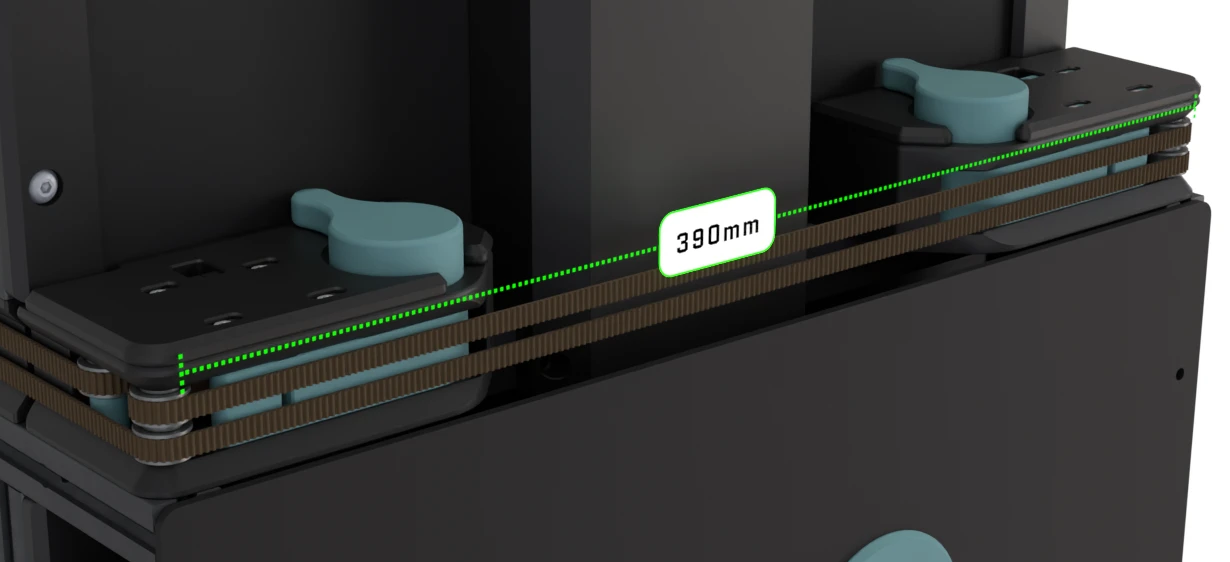
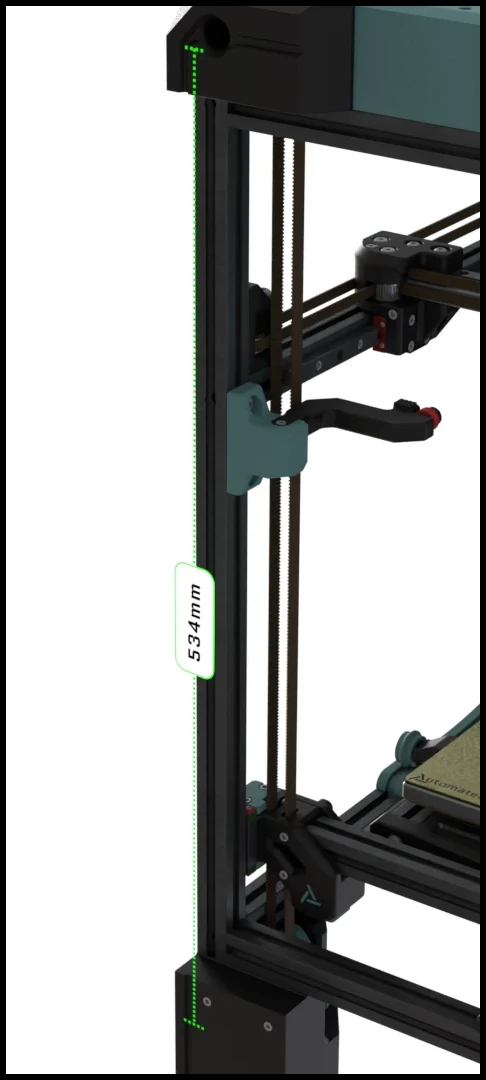
Target Frequencies
X/Y Axis Belts
| Parameter | Value |
|---|---|
| Belt | Gates PowerGrip 2GT · 2mm Pitch · 6mm Width |
| Free span | 0.390 m |
| Linear density (μ) | 0.0083 kg/m |
| Target tension | 26.69 N (6 lbf) |
| Target frequency | 73.2 Hz |
Z Axis Belts
| Parameter | Value |
|---|---|
| Belt | Gates PowerGrip 2GT · 2mm Pitch · 9mm Width |
| Free span | 0.534 m |
| Linear density (μ) | 0.01245 kg/m |
| Target tension | 40.03 N (9 lbf) |
| Target frequency | 83.8 Hz |
Measurement Procedure
- Confirm the free span — the unsupported belt length between contact points with nothing touching it
- Pluck the belt near the middle of the span, like a guitar string
- Measure the frequency with a phone app:
- Android: Spectroid — use FFT mode at the highest FFT size
- iOS: Physics Toolbox Sensor Suite
- Adjust tension until the fundamental frequency matches your axis target above
- Re-measure after each adjustment — tension can shift slightly as the belt settles
- You may have to go back an forth a bit, as the tension in one belt can impact the other. If it’s difficult to get them both to measure equal frequency and correct frequency, its better to have them be equal. Unequal tension can cause the gantry to skew.
- Gates recommends 6–8 lbf for 6mm GT belts in a registration drive; the 9mm Z target of 9 lbf scales proportionally with width
- Ensure nothing contacts the belt along the free span during measurement
- If the reading is noisy, pluck more firmly or reduce nearby vibrations
- These figures assume genuine Gates 2GT belt — third-party belts vary in density and will give inaccurate results with this formula